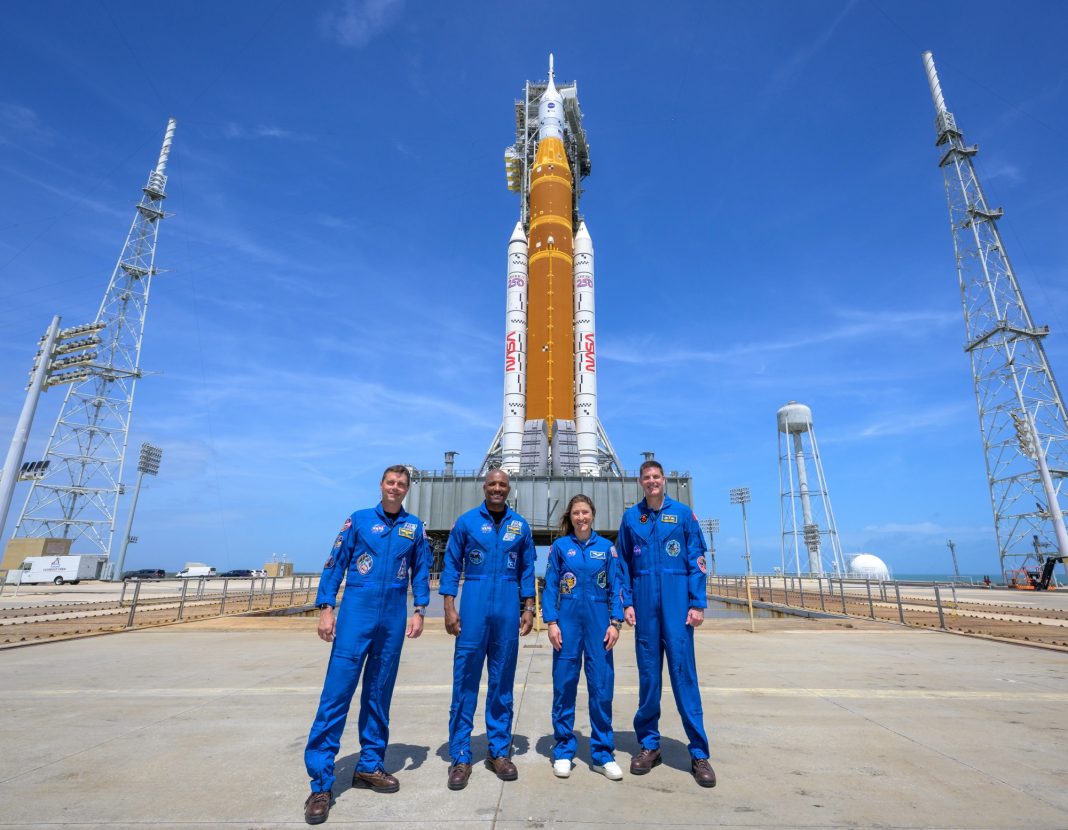
A historic return to deep space could be visible right from Moore County, as NASA prepares to launch Artemis II, the first crewed mission to orbit the Moon in more than 50 years.
The mission will lift off from Kennedy Space Center in Florida, sending four astronauts aboard NASA’s Orion spacecraft on a journey around the Moon and back to Earth.
Among them is mission specialist Christina Koch, who has deep ties to North Carolina. Koch grew up in Jacksonville and later attended the North Carolina School of Science and Math before earning degrees from NC State University.
Koch is set to become the first woman to travel around the Moon, adding another milestone to a career that already includes a record-setting 328-day mission aboard the International Space Station.
When and where to watch
The launch is scheduled for the early evening hours, with a window opening around 6:24 p.m. Eastern, though delays are possible depending on weather and technical conditions.
For viewers in Moore County, visibility will depend largely on timing and sky conditions.
The best chance to see the rocket will be if the launch occurs near sunset, when sunlight can illuminate the exhaust plume high in the atmosphere. That can create a bright, expanding glow visible from hundreds of miles away.
Residents should look toward the southeastern horizon about one to two minutes after liftoff. Under clear skies, the rocket may appear as a bright, moving point of light climbing into the sky, possibly leaving a glowing trail behind it.
Daytime launches are harder to spot, while nighttime launches may still be visible as a bright object moving steadily across the sky.
A mission decades in the making
Artemis II marks the first time astronauts will travel beyond low-Earth orbit since the Apollo era.
The roughly 10-day mission will send the crew on a path around the Moon without landing, traveling farther from Earth than any humans have in decades.
After launch, the crew will spend time in Earth orbit before heading toward the Moon, a trip that will take about three to four days. They will fly thousands of miles beyond the lunar surface before looping back toward Earth on a free-return trajectory, ending with a splashdown in the Pacific Ocean.
The mission serves as a critical test of NASA’s Orion spacecraft and Space Launch System rocket, both of which are central to future missions.
Why Artemis II matters
Artemis II marks a major milestone for NASA and human spaceflight.
It will be the first time astronauts travel beyond low-Earth orbit since the Apollo era, and the first crewed test of the Orion spacecraft and Space Launch System together.
The mission is a key step toward Artemis III, which is expected to land astronauts on the Moon for the first time since 1972.
NASA officials say the broader Artemis program is aimed at establishing a sustained human presence on and around the Moon, with future missions laying the groundwork for eventual human exploration of Mars.
A local connection to a global mission
For North Carolina, Koch’s role adds a local layer to a mission with global significance.
Educators and leaders across the state have pointed to her journey, from North Carolina classrooms to deep space, as an example of what is possible through science and education.
For those watching from Moore County, the launch offers more than just a view of a rocket rising into the sky. It is a chance to witness a moment of history, with roots that trace back to right here in North Carolina.

A Moore County native who has spent more than 20 years telling stories across North Carolina and beyond. He’s worked with CNN, WRAL, and CBS 17, and now serves as a Video Journalist for ABC11. Patrick has a passion for breaking news and has earned multiple awards for his coverage. He’s also a certified NWS SKYWARN Storm Spotter and was among the first news videographers in the state to become an FAA-certified drone pilot.
