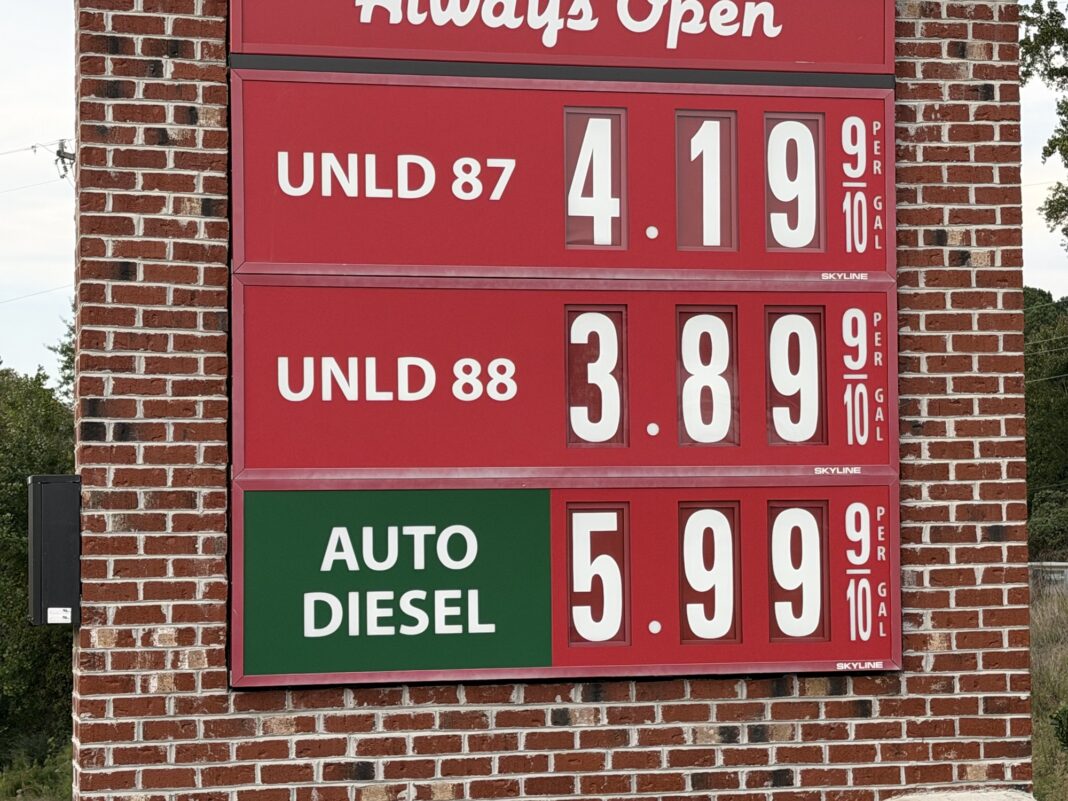
North Carolina drivers could soon see some relief at the gas pump after state lawmakers approved legislation Wednesday to temporarily suspend the state’s 41-cent-per-gallon fuel tax. But how much will Moore County residents actually save, and what could the suspension mean for road projects?
Gov. Josh Stein announced Thursday that he plans to take action Friday on House Bill 3, which passed the General Assembly with overwhelming bipartisan support. Stein has not indicated whether he intends to sign the legislation.
If signed Friday, the gas tax suspension would begin Saturday, Oct. 10, and remain in effect through Nov. 30.
The legislation comes as gasoline prices have increased amid global supply disruptions associated with ongoing conflicts in Ukraine and Iran.
According to AAA, North Carolina’s average gas price Thursday was approximately $4.03 per gallon, compared to $3.84 a month ago and $2.82 at the same time last year.
For Moore County residents who regularly commute between communities such as Carthage, Aberdeen, Southern Pines and Pinehurst, or travel outside the county for work, the suspension could help reduce transportation expenses.
However, eliminating the state fuel tax does not necessarily mean drivers will see prices drop by the full 41 cents per gallon.
How much will drivers actually save?
While the suspension would eliminate the state’s 41-cent-per-gallon fuel tax, that doesn’t necessarily mean drivers will see prices drop by the full amount.
North Carolina collects its fuel tax at the wholesale level, meaning the tax is paid by businesses purchasing fuel rather than motorists directly at the pump.
Gas stations may also have fuel in their tanks that was purchased before the suspension, when the tax was still being collected. As stations replenish their supplies, the lower wholesale costs could begin to influence prices.
However, the legislation does not require retailers to pass the tax savings directly to consumers, leaving some uncertainty about how much drivers will ultimately benefit.
During Wednesday’s legislative debate, Democratic lawmakers unsuccessfully pushed for additional requirements to ensure the savings reached consumers. Republican lawmakers argued that competition among gas stations would encourage retailers to lower their prices.
For Moore County drivers, the impact will depend on how local gas stations adjust their prices in the coming days and weeks, along with other factors that influence fuel costs.
Local businesses that rely heavily on transportation, including contractors, landscaping companies, delivery services and agricultural operations, could also benefit from lower fuel costs if those savings are reflected in retail prices.
What about Moore County road projects?
While the gas tax suspension could provide short-term relief for drivers, the revenue collected from the tax plays an important role in maintaining North Carolina’s transportation infrastructure.
Motor fuel taxes help fund road construction, resurfacing, bridge repairs and other transportation improvements across the state, including projects in Moore County.
According to the North Carolina Department of Transportation, motor fuel taxes account for approximately 40% of state-generated transportation revenue.
The temporary suspension is expected to reduce state transportation revenue by more than $350 million.
To offset that loss, lawmakers included provisions to replace the revenue using money from the state’s Stabilization and Inflation Reserve.
The approach is intended to allow ongoing and planned transportation projects to continue receiving funding without interruptions caused by the temporary tax suspension.
That is particularly important for Moore County, where continued residential and commercial development has increased traffic along major corridors such as U.S. 1, U.S. 15-501 and N.C. 211.
Transportation funding also supports routine maintenance and resurfacing of secondary roads throughout the county, including rural communities outside municipal limits.
Because lawmakers included replacement funding in the legislation, the suspension is not expected to directly affect scheduled road construction or maintenance projects.
However, using state reserves to replace the lost revenue will reduce the amount of money available in that reserve for future needs.
Why are lawmakers suspending the tax now?
The legislation received overwhelming bipartisan support, with Republican and Democratic lawmakers largely agreeing that rising fuel prices have created additional financial pressure on North Carolina residents and businesses.
Republican legislative leaders said the temporary suspension would provide relief for families, commuters, farmers and small businesses, particularly as the holiday travel season approaches.
Some Democratic lawmakers questioned the timing of the legislation, arguing that the General Assembly could have addressed fuel costs earlier in the year.
Democrats also raised concerns about whether the legislation would guarantee savings for consumers, while Republicans maintained that competition among gas stations would encourage retailers to lower prices.
Despite those disagreements, the measure passed both chambers with nearly unanimous support.
What happens after November?
The gas tax suspension is scheduled to expire Nov. 30, meaning the state’s 41-cent-per-gallon tax would return in December unless lawmakers approve an extension.
The temporary measure does not change the underlying factors that influence gasoline prices, including crude oil costs, global supply, demand and distribution expenses.
For Moore County drivers, the suspension could provide some relief over the coming weeks, particularly for those who commute long distances or regularly purchase larger quantities of fuel.
At the same time, the state plans to use reserve funds to ensure transportation projects continue receiving funding during the suspension.
Whether the tax break delivers the full savings drivers might expect remains uncertain. Much will depend on how quickly retailers adjust their prices and how much of the tax reduction is ultimately reflected at the pump.
Stein is expected to announce his decision on the legislation Friday.

A Moore County native who has spent more than 20 years telling stories across North Carolina and beyond. He’s worked with CNN, WRAL, and CBS 17, and now serves as a Video Journalist for ABC11. Patrick has a passion for breaking news and has earned multiple awards for his coverage. He’s also a certified NWS SKYWARN Storm Spotter and was among the first news videographers in the state to become an FAA-certified drone pilot.
